
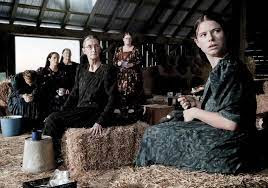
The Guardian describes it as “important” but only gives it three stars out of five, praising the performances – all excellent – but grumbling it sometimes lapses into a school debate. I thought this was unfair. Women Talking is serious, it deals with the essence of feminism in an environment where it is hardly referred to, drama relying on what is said and the way it is expressed.
Women belonging to a religious community in rural USA at the beginning of the twentieth century (Note corrective footnote.), gather in a barn to discuss their reaction to continuing maltreatment by the men of that community. The male malefactors are never seen, in a weakish plot device they are physically absent but present as a menace. Only one man (Ben Whishaw) plays a part; sympathetic to the women but given the neutral role of writing the minutes. Gradually his sympathy grows, meshing with the women’s problems.
What should the women do? Stay and endure the pain? Stay and fight it out (How, is never articulated)? Leave? Obligations of religion and the existence of children complicate these options. The women gradually emerge as individuals, each with different opinions. Discussion melts into argument and some blows are struck.
In a brief cameo the ever-marvellous Frances McDormand preaches Christian submission and eventually pays a price for this view.
The movie is written and directed by a woman, Sarah Polley, and I – as a mere man – think this is an essential element.
Women Talking is uncomfortable, poses painful dilemmas and encourages reflection. Strictly for adults. Are you an adult?
NOTE. My 30-year-old grandson, who saw this movie with me, points out that the events took place in 2010, not 1910 as I misheard. However visual power is achieved by setting it in a wilfully anachronistic community which has rejected many of the aspects of the oughty years.


